UK Online Casino Payment Methods: The Complete 2026 Comparison
 Available in GB

The way you move money in and out of a UK online casino matters more than most players realise until they hit a withdrawal delay or discover their "instant" e-wallet still took three days. Since the credit card ban in April 2020, the payment landscape has shifted: debit cards remain universal, e-wallets trade speed for bonus exclusions, and Open Banking barely survived the regulatory squeeze that killed most Pay N Play casinos by 2024.
This guide maps every payment method that works at UKGC-licensed operators in 2026—what they cost, how fast they actually move, which ones void your welcome bonus before you’ve placed a bet, and where the catches hide. Debit cards, e-wallets, bank transfers, mobile payments, prepaid options: each method wins in a different scenario, and none of them work everywhere anymore.
Table of Contents
- UK Online Casino Payment Methods: What’s Available in 2026
- Debit Cards: The Universal Default
- E-Wallets: Speed vs. Bonus Eligibility
- Bank Transfers and Open Banking
- Mobile Wallets: Apple Pay and Google Pay
- Pay by Mobile: Boku and Phone Bill Deposits
- Prepaid Options: AstroPay and Jeton Cash
- Deposit and Withdrawal Speeds Compared
- How to Choose the Right Payment Method
- Cryptocurrency and Offshore Options
- Rarely Used and Legacy Methods
- Bonuses and First Deposit Offers
UK Online Casino Payment Methods: What’s Available in 2026
UK players can legally use five categories of payment methods at UKGC-licensed casinos: debit cards (Visa, Mastercard), e-wallets (PayPal, Skrill, Neteller, MuchBetter, Jeton), bank transfers and Open Banking (Trustly), mobile wallets (Apple Pay, Google Pay), and prepaid options (Boku pay-by-mobile, AstroPay). Credit cards have been banned since April 14, 2020, under Licence Condition 5.1.1—no exceptions, no workarounds through e-wallets, no offshore loopholes that won’t cost you your winnings if the casino folds.
The Gambling Commission’s rules shape everything: deposits must come from your own funds (no credit, no someone else’s card), withdrawals should return to the deposit source where practical, and every operator verifies your identity before paying out. That verification window—typically 24 to 72 hours on your first withdrawal—adds to whatever the payment method itself claims as processing time. An e-wallet that says "instant" still waits behind a casino’s compliance queue.
| Payment Category | Deposit Speed | Withdrawal Speed | Typical Fees | Bonus Eligibility | Best For |
|---|---|---|---|---|---|
| Debit cards | Instant | 1–3 days | None (GBP) | Yes | Universal acceptance, zero cost |
| E-wallets | Instant | Instant–24h | Varies (conversion fees) | Mixed (PayPal yes, Skrill/Neteller often no) | Fastest withdrawals |
| Bank transfer / Open Banking | Instant (Trustly) / 1–2 days (manual) | 1–24h (Trustly) / 3–7 days (manual) | None | Yes | Privacy, no card storage |
| Mobile wallets (Apple/Google Pay) | Instant | Deposit-only | None | Yes | Biometric speed, mobile convenience |
| Prepaid / Pay-by-mobile | Instant | Deposit-only (Boku) / varies (AstroPay) | None | Yes | Spending control, anonymity |
The Credit Card Ban Explained
Since April 14, 2020, no UKGC-licensed operator can accept credit card deposits. The rule came after Gambling Commission data showed £22.7 million in gambling debt linked to credit card use in 2018–2019—people betting with borrowed money, then unable to pay it back. The ban closed the direct route (card number at the cashier) and the indirect one: you cannot fund an e-wallet with a credit card and then deposit from that wallet to a UK casino. Payment providers like PayPal, Skrill, and Neteller block credit-funded balances from reaching gambling sites.
Debit cards work fine. The distinction is simple: debit draws from money you already have; credit borrows money you will owe. UK regulators treat that difference as a harm-reduction firewall. Searches for "credit card casinos UK" still spike monthly, which says more about habit than availability. Every UKGC operator has been credit-free for over four years.
Why can’t I use a credit card at UK online casinos?
Credit cards have been banned at all UK-licensed casinos since April 14, 2020, under UKGC Licence Condition 5.1.1. The ban prevents gambling with borrowed money, reducing harm from debt-fueled play. This includes direct card deposits and indirect credit-funded e-wallet deposits—operators must verify your payment source is not credit-based.
What the UKGC Rules Mean for Your Payments
The UK Gambling Commission sets three baseline rules that shape how every payment method works. First, source-of-funds verification: operators must confirm deposits come from your own money, not someone else’s account or borrowed funds. Second, the same-method withdrawal rule: where practical, your cashout should return to the payment method you deposited with—an anti-money-laundering measure that stops people depositing with one stolen card and withdrawing to another clean account. Third, know-your-customer checks before withdrawal: every casino verifies your identity (passport or driving licence, proof of address dated within three months) before releasing funds, usually within 24 to 72 hours on first payout.
These rules explain why some methods feel faster than others. A debit card deposit clears instantly, but the withdrawal takes one to three business days because the card network—Visa or Mastercard—needs that time to process the refund back to your bank. An e-wallet like Skrill can move money in seconds once the casino approves it, but you still wait behind the verification queue if you have not cashed out before. The speed on the payment provider’s website is only half the story; the casino’s compliance window is the other half, and no one skips that.
The same-method rule has an exception: deposit-only methods like Boku (pay-by-mobile) or Paysafecard (prepaid vouchers) cannot receive withdrawals because they are one-way systems. In those cases, you set up a bank transfer or e-wallet to cash out. The operator may ask you to verify the new method before releasing funds, which adds another day or two to the first withdrawal.
Five Payment Categories Available
Debit cards (Visa, Mastercard): Accepted at 100% of UK casinos, free for GBP transactions, straightforward to use. Deposits instant; withdrawals one to three business days after approval. The default option and the benchmark everything else is measured against.
E-wallets (PayPal, Skrill, Neteller, MuchBetter, Jeton): Digital wallets that keep your bank and card details away from the casino. Deposits instant; withdrawals process in under 24 hours once approved, often within minutes. The catch: Skrill and Neteller are excluded from welcome bonuses at most UK operators, and currency conversion fees (1.45% to 3.99%) apply if you hold non-GBP balances.
Bank transfer and Open Banking (Trustly): Direct bank-to-casino payments. Traditional manual transfers take one to two business days for deposits and three to seven for withdrawals. Open Banking via Trustly is instant for deposits and one to 24 hours for withdrawals, but only two to four UK casinos still accept it as of 2026—down from over twenty in 2023.
Mobile wallets (Apple Pay, Google Pay): Tokenized debit card payments through your phone. Instant deposits with biometric authentication (Face ID, fingerprint). Deposit-only: you cannot withdraw to Apple Pay or Google Pay, so you need a separate cashout method set up.
Prepaid and pay-by-mobile (Boku, AstroPay): Boku charges deposits to your phone bill (£30 maximum per transaction). AstroPay sells prepaid vouchers (£5 to £250) or works as an e-wallet. Both instant for deposits; Boku is deposit-only, AstroPay mostly deposit-only at UK casinos. Built-in spending control and maximum privacy—no bank details shared.
Debit Cards: The Universal Default
Every UKGC-licensed casino accepts Visa and Mastercard debit cards—universality that no other payment method can match. The 2020 credit card ban left debit as the only card option, and it remains the benchmark for cost, simplicity, and bonus eligibility. If you hold a UK bank account, you already have the payment method that works everywhere, costs nothing for domestic GBP transactions, and qualifies for every welcome offer on the market.
Deposits post instantly. You enter the 16-digit card number, expiry date, and CVV at the cashier; the casino sends it through the card network (Visa or Mastercard); your bank authenticates via 3D Secure 2 (usually a biometric scan or SMS code under Payment Services Directive 2 rules); and the funds appear in your balance within seconds. The authentication layer—mandatory across Europe since 2021—adds one extra step but makes card fraud significantly harder. A stolen card number alone is worthless without the cardholder’s fingerprint or the SMS code sent to their registered phone.
Withdrawals take one to three business days after the casino approves your request. That delay is not the casino stalling—it is the Visa and Mastercard network processing time for refunding money back to your bank account. The card networks treat casino withdrawals as refunds to the original transaction, which means they follow the same rails as a refund from any other merchant. One day is realistic for same-bank transactions; three days is typical when the casino’s acquiring bank and your issuing bank are in different networks or countries. This is slower than e-wallets but faster than traditional bank transfers.
Visa Debit
Visa Inc. operates the world’s largest card network—over 3.9 billion cards in circulation as of 2023, roughly 90% of UK adults holding at least one Visa product. In the UK casino context, Visa debit works at literally every UKGC operator. No casino has dropped Visa; no acquiring bank refuses gambling transactions on Visa debit (though some banks block them on the customer side through voluntary gambling blocks, which is a separate issue).
Visa debit transactions at UK casinos are free. No processing fee from Visa, no surcharge from the casino (UKGC rules prohibit payment-method surcharges), no foreign exchange markup if you are depositing GBP to a GBP casino account. The only cost scenario is currency conversion: if you deposit GBP from a Visa debit card to a casino account denominated in EUR or USD, your bank applies its standard FX rate, typically 2.5% to 3% above the interbank rate. That is your bank’s charge, not Visa’s or the casino’s.
Visa’s 3D Secure 2 implementation—branded as Verify by Visa—uses biometric authentication where your device supports it (fingerprint on Android, Face ID on iPhone) or falls back to SMS one-time passcodes. The authentication window pops up in the deposit flow, you confirm your identity, and the payment completes. Failures are rare once you have verified your card at least once with that casino; subsequent deposits usually skip the full challenge and approve instantly based on risk scoring.
Mastercard Debit
Mastercard Inc. holds the second-largest share of UK card transactions—still universal at casinos, still free for GBP domestic payments, still one to three business days on withdrawals. Mastercard phased out Maestro in July 2023, consolidating everything under the Debit Mastercard brand. If you had a Maestro card (identifiable by 16 digits starting with 5018, 5020, 5038, 5893, 6304, 6759, 6761, or 6763), your bank has replaced it with a standard Debit Mastercard by now.
The practical difference between Visa and Mastercard at UK casinos is nil. Both clear deposits instantly, both take the same one to three days for withdrawals, both authenticate via 3D Secure 2 (Mastercard’s version is branded as Mastercard Identity Check), both cost nothing for GBP transactions. Some players hold legacy beliefs that one network is faster or more reliable than the other—irrelevant in practice. The card network does not set withdrawal speed; the casino’s pending period and the card issuer’s processing time do.
Mastercard does apply slightly different rules to high-value transactions: deposits above £5,000 in a single transaction may trigger additional verification (a phone call from your bank’s fraud team asking you to confirm the payment). That threshold varies by issuing bank. Visa has similar thresholds but enforces them less visibly. For the vast majority of UK casino players depositing £10 to £500 at a time, neither network imposes extra friction.
How Debit Card Deposits Work
You navigate to the casino cashier, select your deposit amount (minimum typically £5 to £10), choose debit card as the payment method, and enter your card details if it is your first deposit at that site. Most casinos store your card details after the first successful transaction, so subsequent deposits require only the CVV and 3D Secure authentication—you do not retype the full 16-digit number each time.
The authentication popup opens: your bank’s 3D Secure 2 interface, asking you to confirm with a fingerprint, Face ID, or SMS code. You authenticate, the popup closes, and the casino balance updates within seconds. The money leaves your bank account immediately. The casino sees a confirmed transaction and credits your account. You can start playing or claim your welcome bonus (debit cards always qualify) without waiting.
Withdrawal Times and Limits
Debit card withdrawals require the casino’s internal approval first. Most UKGC operators hold withdrawals in a "pending" state for 24 to 72 hours while they verify that you are not laundering money, that your account is fully verified (passport and proof of address submitted and approved), and that you have met any bonus wagering requirements. This pending window is not unique to cards—every payment method waits behind it.
Once the casino approves the withdrawal, the payment enters the Visa or Mastercard network for processing back to your bank account. This takes one to three business days. Same bank as the casino’s acquiring bank: one day. Different banks: two to three days. Weekends and UK bank holidays do not count as business days, so a withdrawal approved Friday afternoon will not hit your account until Tuesday at the earliest.
Withdrawal limits depend on the casino, not the card network. Typical caps: £5,000 to £10,000 per transaction, £20,000 to £50,000 per month. VIP players negotiate higher limits directly with the operator. The card network itself imposes no ceiling—Visa and Mastercard can move six-figure sums in a single transaction if the casino and your bank allow it.
Is it safe to save my card details at a UK online casino?
Yes, if the casino holds a current UKGC licence (check gamblingcommission.gov.uk). Licensed operators must store card data under PCI DSS standards—encrypted, tokenized, never in plain text. Your full card number is replaced with a token; the casino cannot see it after the first transaction. 3D Secure 2 authentication adds a second layer: even if the token leaks, it’s useless without your biometric or SMS code.

E-Wallets: Speed vs. Bonus Eligibility
E-wallets process withdrawals faster than any other payment category—often within minutes once the casino approves them, compared to one to three days for debit cards. That speed advantage is why they remain popular despite two significant downsides: Skrill and Neteller are excluded from welcome bonuses at roughly 70% of UK casinos, and currency conversion fees (1.45% to 3.99% depending on the wallet) bite anyone holding non-GBP balances. PayPal and MuchBetter avoid the bonus penalty but accept fewer operators. Jeton exists as the low-profile alternative that barely anyone uses.
The underlying mechanics are identical across all five: you create an account with the e-wallet provider, fund it via debit card or bank transfer, then use the wallet as a buffer between your bank and the casino. Deposits from the wallet to the casino clear instantly. Withdrawals from the casino return to the wallet in under 24 hours (often under one hour), and you can then move funds from the wallet back to your bank account or spend them via a linked prepaid card. The casino never sees your bank details; the wallet provider does.
UKGC rules require e-wallet providers to block credit-funded deposits at gambling sites. If you top up your PayPal or Skrill balance with a credit card, you cannot use those funds at a UK-licensed casino—the transaction declines at checkout. The wallet must be funded by debit card or bank transfer. This closed the indirect credit card loophole that existed before 2020, when players could technically deposit credit money through an e-wallet intermediary.
| E-Wallet | Withdrawal Speed | Fees | UK Casino Acceptance | Bonus Eligibility | Founded |
|---|---|---|---|---|---|
| PayPal | 1–24 hours | Free deposits/withdrawals; 3–4% FX | ~30–40% | Usually yes | 1998 |
| Skrill | Instant–24 hours | Free deposits; £1 bank withdrawal from wallet; 1.45% FX | ~90%+ | Often excluded | 2001 |
| Neteller | Instant–24 hours | Free deposits; 1.50% FX; 3.99% on some pairs | ~90% | Often excluded | 1999 |
| MuchBetter | 1–24 hours | Free deposits/withdrawals; FX applies | ~40% | Usually yes | 2016 |
| Jeton | 0–24 hours | Free deposits/withdrawals; FX applies | ~20–30% | Usually yes | 2017 |
PayPal
PayPal Holdings Inc. (NASDAQ: PYPL) operates the most recognizable e-wallet brand in the UK—household name, trusted for Amazon and eBay purchases, accepted at roughly 30 to 40% of UKGC casinos as of 2026. That acceptance rate has dropped from over 50% in 2020 to 2022, partly because PayPal’s fees to merchants (casinos) are higher than competitors like Skrill, partly because PayPal periodically exits gambling relationships when regulatory scrutiny intensifies. The casinos that still take it tend to be larger, established operators: BetMGM, Virgin Bet, and MrQ confirmed as of late 2026.
PayPal is an FCA-authorized payment institution in the UK (FRN 570140), operating under e-money regulations. UK deposits and withdrawals at casinos are free—no transaction fees from PayPal or the casino. Currency conversion applies if you deposit GBP to a EUR or USD casino account, or vice versa: PayPal charges 3% to 4% above the interbank exchange rate, which is comparable to what your bank charges on a debit card FX transaction. If you keep GBP in your PayPal balance and deposit to a GBP casino account, the cost is zero.
Deposits are instant. You log into the casino cashier, select PayPal, authorize the payment in the PayPal popup (biometric or password), and the funds appear in your casino balance within seconds. Withdrawals process in one to 24 hours after the casino approves them—faster than debit cards, slower than Skrill or Neteller at the quickest casinos. The 24-hour ceiling is rare; most UK operators using PayPal return funds within two to four hours once the pending period ends.
PayPal qualifies for welcome bonuses at the casinos that accept it. This is the critical difference from Skrill and Neteller, which are excluded at most operators. If you deposit £50 via PayPal to claim a 100% match bonus, you receive the £50 bonus. If you deposit the same £50 via Skrill, many casinos void the bonus before you have placed a bet. The bonus terms state this explicitly—check the fine print for "e-wallets excluded" or "Skrill and Neteller excluded." PayPal rarely appears on those exclusion lists.
The main catch with PayPal at UK casinos is availability. Only three to four casinos out of ten accept it. If your preferred operator does not list PayPal in the cashier, you cannot will it into existence—use a debit card or a different e-wallet instead. The casinos that dropped PayPal between 2020 and 2026 have not returned it, and PayPal’s own policy on gambling remains cautious. The company does not advertise casino acceptance; operators negotiate individual merchant agreements, and those agreements can end without warning.
Skrill
Skrill Limited, owned by Paysafe Group (taken private by Blackstone and CVC Capital Partners in 2017), is the most widely accepted e-wallet at UK casinos—over 90% of UKGC operators list it in their cashier. Founded in 2001 as Moneybookers, rebranded to Skrill in 2011, and acquired by Paysafe in 2015 for $1.1 billion, it processes over £40 billion annually across gambling, forex, and e-commerce. Skrill is an FCA-authorized e-money institution (FRN 900015) operating under the same Paysafe UK Limited entity as its sister brand Neteller.
Skrill deposits at UK casinos are instant and free. Withdrawals from the casino back to your Skrill wallet process in under 24 hours at most operators, often within one hour at casinos optimized for e-wallet speed. That is the fastest category available—no other method matches e-wallet payout speed except cryptocurrency at non-UK-licensed sites, which is irrelevant for this guide. Once the funds land in your Skrill wallet, you can withdraw them to your UK bank account: instant withdrawals cost £1.00 per transaction; standard bank transfers are free but take one to two business days.
The fee structure: deposits to your Skrill wallet via UK debit card or bank transfer are free. Deposits from your Skrill wallet to a casino are free. Withdrawals from the casino back to Skrill are free. Moving money from Skrill to your bank account costs £1 if you want it instantly (within minutes) or free if you accept the one to two-day wait. Currency conversion within Skrill—holding GBP and spending EUR, or vice versa—costs 1.45% above the interbank rate. That is lower than Neteller’s 1.50% but higher than keeping everything in one currency.
Skrill is excluded from welcome bonuses at approximately 70% of UK casinos. The exclusion is operator policy, not a UKGC rule. Casinos blacklist Skrill (and Neteller) because e-wallet users historically abused bonuses at higher rates than card users: deposit with Skrill, claim the bonus, complete minimum wagering, withdraw instantly via Skrill, repeat at the next casino. E-wallets make bonus hunting frictionless, so operators remove the incentive by voiding bonuses for e-wallet deposits. Check the bonus terms before depositing—if it says "Skrill excluded," your deposit will not qualify.
The regulatory change that makes this less painful: as of January 2026, UKGC rules cap all bonus wagering requirements at 10x the bonus value. Before that, operators routinely imposed 40x to 50x wagering, which meant a £50 bonus required £2,000 in bets before you could withdraw. At 10x, the same £50 bonus needs only £500 wagering. Lower wagering makes the Skrill bonus exclusion hurt less—you are giving up a smaller edge. If you prioritize fast withdrawals over bonuses, Skrill is still the best tool.
Why are Skrill and Neteller excluded from casino bonuses?
Casinos exclude Skrill and Neteller from bonuses to prevent abuse. E-wallets enable instant deposits and fast withdrawals, making it easy to claim a bonus, meet minimum wagering, cash out immediately, and repeat elsewhere. Operators block this by voiding bonuses for e-wallet deposits. PayPal and MuchBetter usually qualify because they have lower UK acceptance, limiting bonus-hunting efficiency.
Neteller
Neteller, also owned by Paysafe Group and operating under the same FCA license (FRN 900015) as Skrill, is near-identical in speed, acceptance, and bonus exclusion. Founded in 1999, acquired by Optimal Payments (now Paysafe) in 2004, it processes over $80 billion annually and is accepted at roughly 90% of UK casinos. The practical difference between Neteller and Skrill is negligible—same parent company, same casino acceptance rate, same instant-to-24-hour withdrawal speeds, same bonus blacklist at 70% of operators.
Neteller’s fee structure differs slightly: deposits to your Neteller wallet and from the wallet to casinos are free. Withdrawals from casinos back to Neteller are free. Moving funds from Neteller to your UK bank account is free for standard transfers (one to two business days). Currency conversion costs 1.50% above interbank rates—marginally higher than Skrill’s 1.45%. On certain non-standard currency pairs (exotic currencies outside GBP/EUR/USD), Neteller applies 3.99%, which is steep. For UK players depositing GBP to GBP casino accounts, the cost is zero.
The question most players ask: why choose Neteller over Skrill when they are functionally identical? Legacy preference. Some players opened Neteller accounts in the early 2000s before Skrill existed and never saw a reason to switch. Others find Neteller’s interface slightly cleaner or prefer its customer support response times. The differences are subjective and minor. If you already use one, there is no compelling reason to switch to the other. If you are choosing fresh, Skrill’s 1.45% conversion fee beats Neteller’s 1.50%, but the gap only matters if you regularly convert currencies.
Both Skrill and Neteller remain dominant because they work everywhere. Ninety percent acceptance means you can open one wallet, fund it once, and use it at nearly every UK casino without setting up new payment methods at each site. PayPal’s 30 to 40% acceptance and MuchBetter’s 40% cannot match that coverage. For players who rotate between multiple casinos—and for bonus hunters who still value the instant payout speed despite exclusion from bonuses—Skrill and Neteller are infrastructure.
MuchBetter
MuchBetter Limited is a UK-registered, FCA-authorized e-money institution (FRN 900872) founded in 2016 and built specifically for gambling transactions—95% of its payment volume is gambling-related. The app is mobile-first (iOS and Android only, no desktop web interface) with fingerprint and Face ID authentication, spending control features (daily and weekly deposit limits set in-app), and real-time transaction notifications. It processes over £2 billion annually across 90+ countries and is accepted at roughly 40% of UK casinos as of 2026, including major operators like Bet365, William Hill, Ladbrokes, 32Red, MrQ, and Casumo.
MuchBetter deposits are instant via the app. You scan a QR code at the casino cashier or enter your MuchBetter-registered phone number, authenticate with a fingerprint or Face ID, and the payment completes within seconds. Withdrawals from the casino back to your MuchBetter wallet process in one to 24 hours after approval—comparable to PayPal, slightly slower than Skrill at the fastest casinos. Deposits and withdrawals are free; currency conversion applies if you hold GBP in MuchBetter and deposit to a EUR casino account, but the rate is competitive with other e-wallets.
MuchBetter qualifies for welcome bonuses at most UK casinos that accept it. This is the key advantage over Skrill and Neteller. The bonus exclusion lists typically name Skrill and Neteller explicitly but omit MuchBetter, either because operators view it as lower-risk for bonus abuse (smaller user base, less established) or because MuchBetter’s commercial agreements with casinos include bonus eligibility as a selling point. Check the specific casino’s terms, but in practice, MuchBetter works for bonuses more often than not.
The mobile-first design is polarizing. Players who manage finances primarily on a phone appreciate the streamlined interface and biometric speed. Players who prefer desktop banking or who regularly move large sums find the lack of a web interface restrictive. You can view your balance and transaction history in the app but cannot access MuchBetter from a laptop browser—unusual in 2026, when most fintech products offer both mobile and web.
MuchBetter’s spending controls are more granular than Skrill’s or Neteller’s. You set daily and weekly deposit limits within the app; the wallet enforces them regardless of which casino you are depositing to. If you cap yourself at £100 per week and attempt a £150 deposit on Thursday, the transaction declines even if the casino would accept it. This is useful for players managing gambling budgets proactively rather than relying on casino-side deposit limits, which vary by operator and require setting separately at each site.
Jeton
Jeton Wallet is a UK-registered, FCA-authorized e-money institution (FRN 900576) founded in 2017, offering three products: a wallet (two-way deposits and withdrawals), JetonCash prepaid vouchers (deposit-only, €5 to €250 denominations), and Jeton Card (a physical contactless Mastercard linked to the wallet). Acceptance at UK casinos sits around 20 to 30%—lower than Skrill, PayPal, or MuchBetter—but growing slowly. The wallet supports multi-currency balances (GBP, EUR, USD) and processes deposits instantly, withdrawals in zero to 24 hours after approval.
Jeton deposits and withdrawals are free for players. Currency conversion fees apply but are not published prominently—anecdotal reports suggest similar rates to Skrill (around 1.5%). JetonCash vouchers work like Paysafecard: you buy a voucher code online, enter the 16-digit code at the casino cashier, and the deposit clears instantly. The voucher is anonymous and deposit-only; you cannot withdraw to it. The wallet, by contrast, supports two-way transactions at casinos that enable Jeton withdrawals.
Jeton qualifies for bonuses at most casinos that accept it. Bonus exclusion lists typically target Skrill and Neteller by name; Jeton escapes by being lesser-known. The challenge is finding casinos that accept Jeton in the first place. Twenty to 30% coverage means seven to eight casinos out of ten do not list it, so you cannot rely on it as a primary payment method unless you stick to the subset of operators that support it.
The physical Jeton Card is a niche feature. You load funds into your Jeton wallet from a casino withdrawal, then spend that balance via the contactless Mastercard at shops, ATMs, or online retailers. It turns casino winnings into spendable money without moving them to your bank account first—useful if you want to keep gambling funds separate from household finances. The card is issued by Transactive Systems and functions like any prepaid Mastercard.
Which payment method has the fastest withdrawal time?
E-wallets offer the fastest withdrawal times: Skrill and Neteller process payouts in under 24 hours after casino approval, often within one hour. PayPal and MuchBetter take one to 24 hours. Debit cards take one to three business days. However, every method waits behind the casino’s pending period (typically 24–72 hours for KYC checks), so total time from request to money in hand is one to three days for e-wallets, two to five days for cards.

Bank Transfers and Open Banking
Bank transfers move money directly between your bank account and the casino’s without storing card details or creating an e-wallet intermediary. Traditional manual bank transfers take one to two business days for deposits and three to seven for withdrawals—the slowest option available. Open Banking via Trustly promised to fix that with instant deposits and same-day withdrawals, and it delivered for a few years. Then UKGC enforcement on know-your-customer verification killed the Pay N Play casino model that Trustly enabled, and by late 2026 only two to four UK operators still accept it.
Trustly and Open Banking: How It Works
Trustly Group AB is a Swedish fintech founded in 2008, publicly listed on Nasdaq Stockholm (TRUST) since 2021, and operating across the EU and UK under Payment Services Directive 2. It holds a payment institution license from Sweden’s Finansinspektionen and is FCA-registered in the UK. Trustly connects to all major UK banks—Barclays, HSBC, Lloyds, Nationwide, Santander, NatWest, and dozens more—via Open Banking APIs mandated under PSD2. You do not create a Trustly account; you authenticate directly through your own bank’s login.
The deposit flow: you select Trustly at the casino cashier, choose your bank from a dropdown, log into your online banking via a popup (the same login you use for your bank’s website or app), authorize the payment amount, and the funds post to your casino balance instantly. Trustly receives a confirmation from your bank in real time, forwards it to the casino, and the casino credits your account. The entire process takes 30 to 60 seconds. Your bank account is debited immediately; Trustly holds no funds—it is a payment gateway, not an e-wallet.
Withdrawals at casinos that support Trustly payouts work in reverse: the casino initiates a payout to your bank account via Trustly, your bank receives the instruction through Open Banking rails, and the money appears in your account within one to 24 hours. The fastest UK casinos process Trustly withdrawals in under one hour once the pending period ends. This is faster than debit cards (one to three days) and comparable to e-wallets (instant to 24 hours).
Trustly is free for players. No transaction fees, no currency conversion charges (the payment moves in GBP from your GBP bank account to the casino’s GBP account), no account maintenance costs. The casino pays Trustly roughly 0.8% per transaction—lower than credit card processing fees (1.5% to 2.5%) but still a cost, which is why some operators prefer e-wallets or cards that shift more of the fee burden to the player via FX markups.
Why Trustly Casinos Became Rare in the UK
Trustly’s UK casino acceptance collapsed between 2024 and 2026. As of October 2026, only two to four UKGC-licensed operators accept it: SpinYoo and DAZN Bet confirmed, with scattered reports of one or two others. This is down from over twenty Trustly casinos in 2023. The reason: enhanced know-your-customer requirements under UKGC enforcement made Trustly’s "instant play" proposition incompatible with regulatory reality.
Trustly underpinned the Pay N Play casino model—sign up with your bank account, deposit, and play within one minute without submitting a passport or proof of address. The casino verified your identity through your bank login, which confirmed you are a real person with a legitimate bank account. That was sufficient for a few years. Then the UKGC tightened affordability checks and source-of-funds verification in 2023 and 2024, requiring operators to collect more documentation before allowing significant deposits or any withdrawals. Pay N Play casinos could no longer deliver on "instant play"—they still needed your ID and utility bill before paying out—so the model’s value proposition evaporated.
Most UK operators using Trustly decided the payment method was not worth supporting if they had to implement traditional KYC anyway. Trustly’s 0.8% fee is competitive but not dramatically cheaper than debit card processing, and debit cards work at 100% of casinos while Trustly’s UK coverage shrank to single digits. Players who valued Trustly for speed found that e-wallets (Skrill, PayPal) offered comparable withdrawal times without the registration friction, and players who valued it for privacy discovered that UK casinos now require the same verification documents regardless of payment method.
Trustly still thrives in markets with lighter KYC requirements—Sweden, Finland, Germany—where Pay N Play remains viable. In the UK, it is effectively a legacy payment method kept alive by a handful of operators for players who already use it.
What is Open Banking and how does it work for casino payments?
Open Banking lets you pay directly from your bank account via secure APIs under PSD2 rules. At a casino, you select Trustly (the main Open Banking provider), log into your bank, authorize the payment, and funds transfer instantly—no card details entered. Withdrawals return to your bank in one to 24 hours where supported. Only two to four UK casinos accept Trustly as of 2026, down from 20+ in 2023.
Traditional Bank Transfer
Manual bank transfers—logging into your bank, entering the casino’s account details (sort code, account number, reference), and submitting the payment yourself—remain available at every UK casino as a fallback deposit method. Deposits take one to two business days to clear; withdrawals take three to seven business days. This is the slowest option in 2026, used primarily by players who cannot or will not use cards or e-wallets.
The advantage is universality and zero cost. Every UK casino accepts bank transfers because they are non-negotiable under UK banking law—any business can receive a bank transfer. The casino lists its bank details in the cashier; you copy them into your online banking; you initiate the transfer. No fees from your bank (UK domestic transfers are free under current-account rules), no fees from the casino. Currency conversion only applies if you send GBP to a EUR casino account, in which case your bank’s standard FX rate applies.
The disadvantage is speed and friction. A deposit initiated Monday morning arrives Tuesday afternoon at the earliest, Wednesday if your bank is slow. Withdrawals take three to five business days minimum, seven if the casino’s bank is outside the UK or if you request a payout on a Friday. You cannot play immediately after depositing; you wait. For withdrawals, that wait stacks on top of the casino’s pending period, so a "three-day bank transfer" becomes five to ten days total from request to money in hand.
Manual bank transfers are a last-resort option in 2026. Use them if your card is blocked, your e-wallet account is suspended, or you are moving a five-figure sum where the extra two days do not matter. For regular play, any other method is faster.

Mobile Wallets: Apple Pay and Google Pay
Apple Pay and Google Pay tokenize your existing debit card for mobile payments—biometric authentication (Face ID, Touch ID, fingerprint) replaces entering your card number and CVV. Both work only on mobile devices: Apple Pay on iPhone, iPad, Mac via Safari; Google Pay on Android phones and tablets. Both are deposit-only at UK casinos—you cannot withdraw to Apple Pay or Google Pay. Once you have deposited, you cash out via debit card (the underlying card you linked) or set up a separate withdrawal method like an e-wallet or bank transfer.
Apple Pay
Apple Pay is a passthrough tokenization service by Apple Inc., launched in the UK in October 2014. It does not hold a payment license; it tokenizes your Visa or Mastercard debit card that your bank issued. When you add a card to Apple Wallet, Apple generates a unique Device Account Number (a token) that replaces your real card number. That token is stored on your iPhone or iPad’s secure enclave chip. When you pay with Apple Pay, the token is sent instead of your card number, and your bank matches it to your account.
Accepted at roughly 50 to 60% of UK casinos as of 2026—higher than PayPal, lower than Skrill. Major operators confirmed: BetMGM, LeoVegas, 10Bet. Deposits are instant: tap the Apple Pay button in the casino cashier, authenticate with Face ID or Touch ID, and the payment completes within seconds. The casino receives a confirmed transaction from your bank via the Visa or Mastercard network; your bank account is debited immediately. The experience is faster than typing a 16-digit card number and CVV, but the backend processing is identical to a standard debit card deposit.
Apple Pay qualifies for welcome bonuses—it is treated as a debit card deposit because that is what it is. No fees: you pay whatever your underlying debit card charges (zero for UK GBP domestic transactions). Withdrawal limits are the same as your card’s limits (typically £5,000 to £10,000 per transaction). You cannot withdraw to Apple Pay; the cashout goes to the debit card you linked, which means one to three business days via the card network.
The limitation is mobile-only. Apple Pay works in Safari on Mac for online payments, but most UK casino sites do not enable that integration—mobile-only in practice. If you primarily play on a desktop PC or laptop, Apple Pay is irrelevant.
Google Pay
Google Pay (rebranded from Android Pay in February 2018) is Google’s equivalent tokenization service for Android devices. Like Apple Pay, it does not hold a payment license—it tokenizes your Visa or Mastercard debit card. Acceptance at UK casinos is slightly lower than Apple Pay, around 40 to 50%: Casumo, Betway, and some Bet365 products confirmed, though availability varies by casino tech stack.
Deposits are instant: tap Google Pay in the cashier, authenticate with your fingerprint or PIN, and the payment posts to your casino balance within seconds. Your bank account is debited immediately. The backend runs through Visa or Mastercard, so the transaction appears on your bank statement as a debit card purchase. No fees for GBP domestic transactions; currency conversion applies if you deposit to a non-GBP casino account.
Google Pay qualifies for bonuses (treated as debit card). Deposit-only: withdrawals return to your underlying debit card, one to three business days. Mobile-only: works on Android phones and tablets, not desktop browsers. The practical difference between Google Pay and Apple Pay is platform: iPhone users pick Apple Pay, Android users pick Google Pay, and both groups get the same experience—biometric speed, deposit-only limitation, bonus eligibility, no fees.
Pay by Mobile: Boku and Phone Bill Deposits
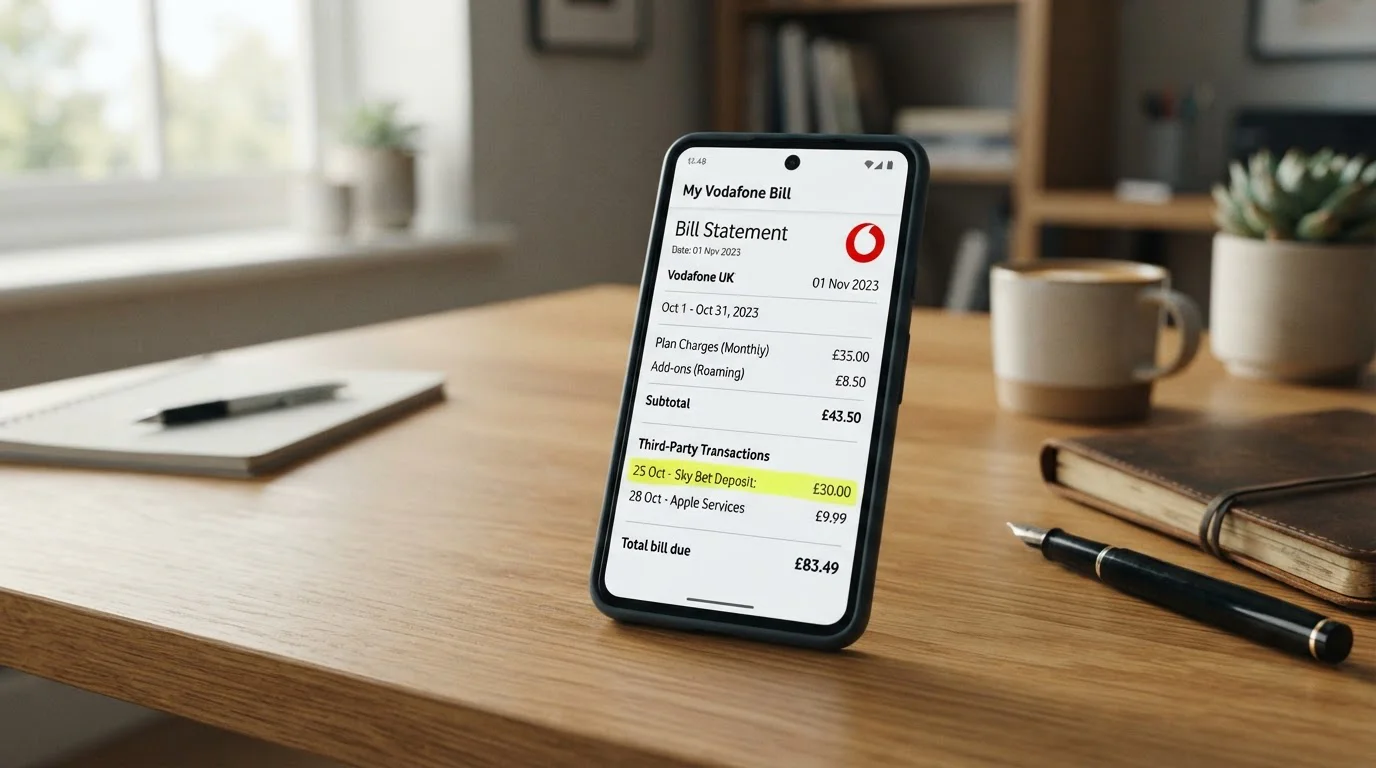
Boku Inc. (NASDAQ: BOKU) is a USA-based mobile payment aggregator founded in 2008 and publicly traded since 2021. It provides direct carrier billing—deposits charged to your mobile phone bill (postpaid contracts) or deducted from your pay-as-you-go credit. Boku partners with all four major UK mobile networks: EE, Vodafone, O2, Three. Accepted at roughly 60 to 70% of UK casinos as of 2026: IvyCasino, Oreels, and Bet442 confirmed, all operated by Betable Limited under UKGC licence 23328.
How Boku Works
You select "Pay by Mobile" or "Boku" at the casino cashier, enter your UK mobile phone number, choose your deposit amount (minimum £5 to £10, maximum £30 per transaction), and confirm via SMS. Boku sends a text message with a verification code; you reply or enter the code; the deposit posts to your casino balance instantly. The charge appears on your next phone bill (postpaid) or is deducted immediately from your pay-as-you-go balance (prepaid). No bank details, no card number, no e-wallet account—just your phone number.
The £30 per-transaction cap cannot be raised. It is enforced by the mobile networks, not by casinos or Boku. If you want to deposit £60, you make two separate £30 transactions. Monthly caps vary by carrier: typically £240 to £400 across all gambling sites combined, not per casino. The networks track your total Boku gambling spend across every operator and decline further deposits once you hit the monthly threshold. This is a built-in spending control—useful for players managing gambling budgets, frustrating for high rollers.
Boku deposits are free for players. The casino pays Boku roughly 15% per transaction—the highest processing fee in the payment industry, which is why some operators exclude Boku from promotions or impose minimum deposit amounts higher than other methods. For a £20 Boku deposit, the casino receives £17 after fees. That economics limits how aggressively casinos promote Boku, but the method remains available because it captures players who will not or cannot use cards or e-wallets.
Deposit Limits and Spending Control
The £30 per-transaction limit and £240 to £400 monthly cap make Boku unsuitable for high-stakes players. If you routinely deposit £100 or £500, Boku is not the tool. Where it works: casual players depositing £10 to £20 at a time who want an automatic spending ceiling they cannot bypass mid-session. Once you hit your monthly cap, Boku declines all further deposits until the calendar month rolls over. No appeals, no emergency top-ups, no convincing customer support to lift the limit.
The spending control is stricter than casino-side deposit limits, which you can adjust by contacting support or waiting 24 hours. Boku’s limit is network-enforced and cannot be circumvented without switching to a different payment method. For players who struggle with impulse deposits, this is a feature. For everyone else, it is a constraint.
Which UK Casinos Accept Boku
Boku acceptance hovers around 60 to 70%, comparable to PayPal but lower than debit cards (100%) or Skrill (90%+). Betable Limited’s three brands—IvyCasino, Oreels, Bet442—are notable for charging zero fees on Boku deposits: a £10 Boku deposit gives you £10 in your balance. Most other operators absorb the 15% Boku fee into their overall pricing but do not charge you explicitly. Check the deposit screen: if it says "£10 deposit = £10 credited," you pay no markup; if it says "£10 deposit = £8.50 credited," the casino is passing Boku’s fee to you (rare but legal).
Boku qualifies for welcome bonuses at most casinos that accept it. Bonus terms occasionally exclude pay-by-mobile methods to limit bonus abuse—check before depositing—but exclusions are less common than for Skrill and Neteller. Boku’s £30 transaction cap and monthly limits naturally throttle bonus hunting, so operators view it as lower-risk.
You cannot withdraw to Boku. Phone bills are one-way payment rails. When you cash out, you set up a bank transfer, e-wallet, or debit card withdrawal. This adds an extra step: verify the new payment method, wait for casino approval, then wait for the method’s processing time. First-time Boku users often do not realise this until they try to withdraw and discover they need to provide a bank account for payout.
Prepaid Options: AstroPay and Jeton Cash
Prepaid vouchers and cards offer maximum privacy—no bank account linked, no card details stored, no transaction history tied to your identity beyond the purchase of the voucher itself. AstroPay is the most established in this category, accepted at 30 to 40% of UK casinos. Jeton Cash (covered earlier under Jeton) functions similarly but with lower acceptance. Both are instant for deposits and deposit-only at most operators—you cannot withdraw to a voucher, so you need a bank transfer or e-wallet for cashouts.
AstroPay
AstroPay LLP is a UK-registered fintech founded in 2009, FCA-authorized (FRN 900582), operating in 150+ countries. The company offers two products: AstroPay Card (prepaid virtual vouchers with 16-digit codes, expiry dates, and CVV, purchased online in £5 to £250 denominations) and AstroPay Wallet (an e-wallet supporting both deposits and withdrawals at some casinos). Most UK casinos treat AstroPay as deposit-only, even when the wallet technically supports payouts—the operators integrate only the deposit flow.
AstroPay Card vouchers are anonymous. You buy a voucher from AstroPay’s website or a third-party reseller, pay via debit card or bank transfer, and receive the 16-digit code immediately. At the casino cashier, you enter the code as if it were a credit card (16 digits, expiry, CVV), and the deposit clears instantly. The voucher balance decreases by the deposit amount. If you bought a £50 voucher and deposit £20, £30 remains on the code for future use. No casino sees your bank details; AstroPay sees your purchase history, but the casino does not.
Deposits via AstroPay are instant and free for players. The casino pays AstroPay a processing fee (undisclosed, likely 2% to 4%). You pay face value for the voucher—a £50 voucher costs £50—with no markup at the casino cashier. Currency conversion applies if you buy a GBP voucher and deposit to a EUR casino account, but AstroPay’s conversion rates are competitive with e-wallets (around 2% to 3% above interbank).
AstroPay qualifies for bonuses at most casinos that accept it. The prepaid nature does not trigger bonus exclusions the way Skrill and Neteller do. If the bonus terms say "AstroPay excluded," they state it explicitly—check the fine print—but most operators treat AstroPay as bonus-eligible.
The loyalty program: AstroPay awards AstroPoints on every deposit (one point per £1), redeemable for gift cards or cash once you accumulate enough. This is unique among payment methods—Skrill, PayPal, and debit cards offer no rewards. The points partially offset AstroPay’s primary drawback: you cannot withdraw to a voucher. When you cash out, you provide a bank account or e-wallet, verify it, and wait for the casino’s standard withdrawal processing. If you are using AstroPay for privacy, this breaks the anonymity layer—the casino still gets your bank details eventually.
Deposit and Withdrawal Speeds Compared
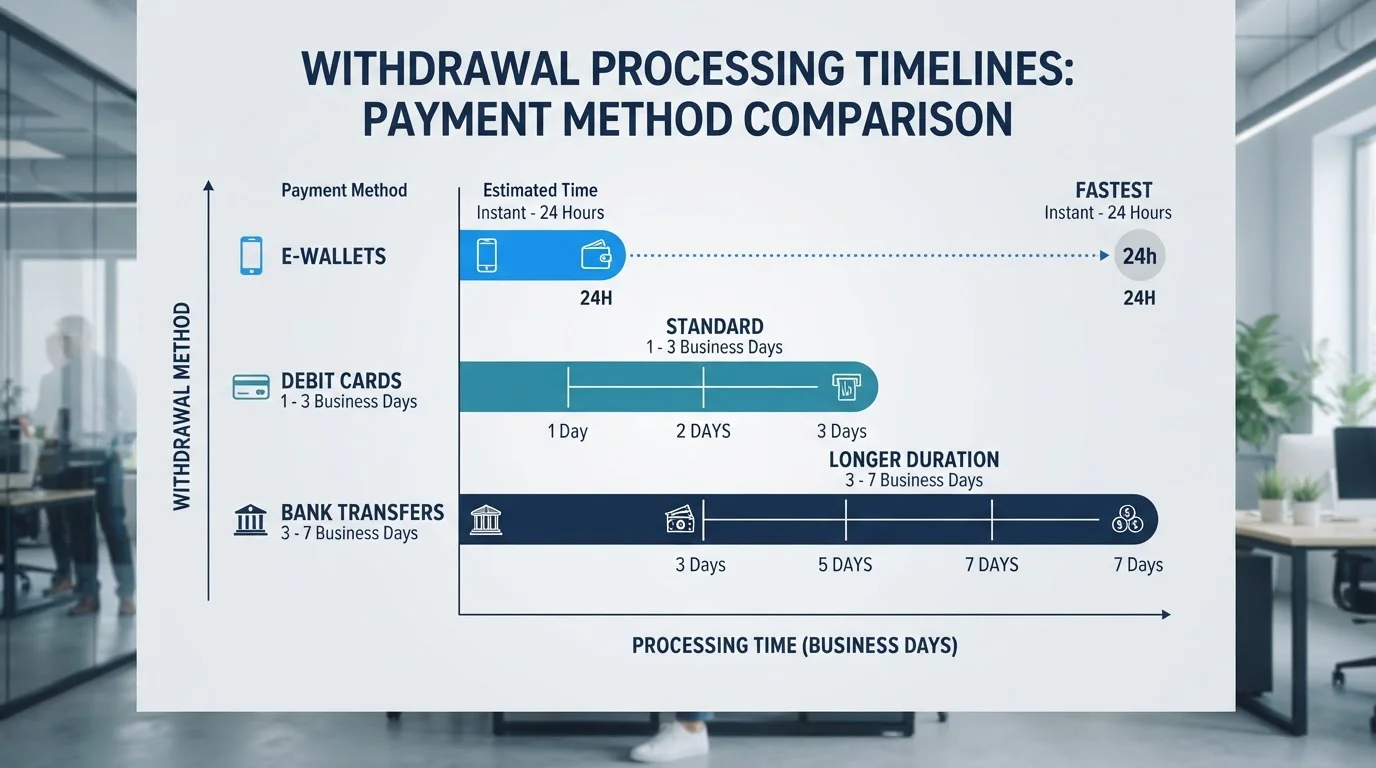
Payment method marketing promises "instant deposits" and "fast withdrawals" without defining what those terms mean in practice. Instant deposits are genuinely instant for every electronic method—debit cards, e-wallets, mobile wallets, Boku, AstroPay—because the transaction confirms within seconds. Bank transfers are the exception: one to two business days for manual transfers, instant for Trustly where available. Withdrawals are where the differences matter, and where the advertised speed diverges from the total time you actually wait.
Every UK casino holds withdrawal requests in a pending state for 24 to 72 hours while they verify your identity (passport, proof of address), check for bonus abuse, and satisfy UKGC anti-money-laundering requirements. This pending window applies to all payment methods without exception. A casino that says "instant e-wallet withdrawals" means instant after the pending period ends—not instant from the moment you click withdraw. First-time withdrawals at a new casino take the full 72 hours for verification. Subsequent withdrawals at the same casino, once your account is fully verified, may skip straight to payout, but many operators enforce a 24-hour minimum pending window regardless.
After the casino approves your withdrawal, the payment method’s processing time determines how long until the money reaches your bank account or wallet. E-wallets (Skrill, Neteller, PayPal, MuchBetter) clear in under 24 hours, often under one hour. Debit cards take one to three business days via the Visa and Mastercard networks. Bank transfers take three to seven business days. Trustly takes one to 24 hours where supported, but only two to four UK casinos offer it.
| Payment Method | Deposit Speed | Withdrawal Speed (After Approval) | Casino Pending Period | Total Realistic Time | Fees |
|---|---|---|---|---|---|
| Debit cards (Visa/Mastercard) | Instant | 1–3 business days | 24–72 hours | 2–5 days | None (GBP) |
| Skrill | Instant | Instant–24 hours | 24–72 hours | 1–3 days | £1 bank withdrawal from wallet; 1.45% FX |
| Neteller | Instant | Instant–24 hours | 24–72 hours | 1–3 days | 1.50% FX; 3.99% on exotic pairs |
| PayPal | Instant | 1–24 hours | 24–72 hours | 1–3 days | 3–4% FX |
| MuchBetter | Instant | 1–24 hours | 24–72 hours | 1–3 days | FX applies |
| Jeton | Instant | 0–24 hours | 24–72 hours | 1–3 days | FX applies |
| Trustly | Instant | 1–24 hours | 24–72 hours | 1–3 days | None |
| Apple Pay / Google Pay | Instant | Deposit-only (card withdrawal: 1–3 days) | 24–72 hours | 2–5 days via card | None (GBP) |
| Boku | Instant | Deposit-only (must use alternative method) | 24–72 hours | Varies by chosen method | None for deposit |
| AstroPay | Instant | Mostly deposit-only (bank/e-wallet withdrawal varies) | 24–72 hours | Varies by chosen method | None for deposit |
| Bank transfer (manual) | 1–2 business days | 3–7 business days | 24–72 hours | 5–10 days | None |
Realistic Withdrawal Timelines
The table above shows what happens in practice. An e-wallet withdrawal requested Monday morning lands in your wallet Wednesday afternoon at the earliest (24-hour pending + instant payout), Thursday if the casino takes 48 hours to approve, Friday if they take the full 72. A debit card withdrawal requested Monday arrives in your bank account Thursday to Saturday (24-to-72-hour pending + one-to-three-day card processing). These timelines assume your account is already verified; first-time withdrawals add another 24 to 48 hours for document checks.
The casinos that advertise "same-day withdrawals" or "instant payouts" are highlighting the post-approval speed while downplaying the pending window. MrQ and Casumo earned reputations in 2025 and 2026 for processing payouts quickly—sometimes within hours for verified players—but even they cannot skip identity verification entirely on first cashouts. Read "instant" as "instant once approved," not "instant from request."
Pending Periods Explained
The 24-to-72-hour pending window exists for three reasons. First, identity verification: the casino checks your passport or driving licence against your account details and confirms your address with a recent utility bill or bank statement. This is mandatory under UKGC rules and cannot be waived. Second, bonus wagering checks: if you claimed a welcome bonus, the casino verifies you met the rollover requirements before releasing funds. Third, anti-money-laundering holds: large or suspicious withdrawals trigger manual reviews, sometimes extending the pending period beyond 72 hours.
Pending periods are adjustable at some casinos—VIP players negotiate shorter holds, sometimes bypassing the queue entirely for instant approval. Standard players wait. The pending window serves one other function: cooling-off. UKGC guidelines encourage operators to give players a chance to reverse impulsive withdrawal requests during the pending window, reducing the harm from chasing losses. You can cancel a pending withdrawal and play with the funds again, which is both a player-protection feature and a retention tactic.
How long does it take to withdraw from a UK online casino?
Withdrawal times depend on the payment method and the casino’s pending period. E-wallets (Skrill, Neteller, PayPal, MuchBetter) are fastest: one to three days total (24–72-hour pending + instant-to-24-hour payout). Debit cards take two to five days (pending + one-to-three-day card processing). Bank transfers take five to ten days (pending + three-to-seven-day transfer). First-time withdrawals add 24–48 hours for identity verification.
Do I have to use the same method to withdraw as I did to deposit?
Usually, yes. UKGC anti-money-laundering rules require withdrawals to return to the deposit source where practical. If you deposited with a debit card, your cashout goes back to that card. Exceptions: deposit-only methods (Boku, Paysafecard, Apple Pay, Google Pay) require you to set up a bank transfer or e-wallet for withdrawal. If your original deposit method no longer works (card expired, wallet closed), casinos allow alternative withdrawals after verifying your identity.
Deposit and Withdrawal Limits by Method
Deposit minimums at UK casinos typically range from £5 to £10 across all methods except Boku, which starts at £5 but caps at £30 per transaction. Maximum deposits per transaction: debit cards £10,000 to £50,000 (set by card issuer and casino), e-wallets £5,000 to £20,000, bank transfers £50,000+, Boku £30. Monthly deposit limits vary by casino and are adjustable in your account settings, subject to UKGC affordability checks above certain thresholds (some operators request payslips or bank statements for cumulative deposits exceeding £1,000 to £2,000 per month).
Withdrawal minimums: £10 to £20 at most casinos. Maximums per transaction: £5,000 to £10,000 for standard players, £20,000 to £100,000 per month. High rollers negotiate bespoke limits. The payment method itself rarely imposes withdrawal ceilings—Visa and Mastercard can process six-figure sums in one transaction if the casino and your bank allow it. The constraint is casino-side risk management, not payment infrastructure.
Currency conversion fees apply when you deposit GBP to a EUR casino account or vice versa, regardless of method. Debit cards: your bank charges 2.5% to 3% over interbank rates. E-wallets: 1.45% (Skrill) to 3.99% (Neteller on exotic pairs) to 3–4% (PayPal). Trustly: no conversion fee; the payment moves in the account’s native currency. Mobile wallets and Boku: inherit your card’s FX rate.

How to Choose the Right Payment Method
No single payment method wins on every axis. Debit cards are universal but slow on withdrawals. E-wallets are fast but often excluded from bonuses. Bank transfers cost nothing but take a week. Mobile wallets work only on phones. Prepaid options protect privacy but lock you into deposit-only. The best choice depends on which trade-offs you will accept and which benefits you value.
Fastest Payouts: E-Wallets
If you prioritize fast withdrawals above all else, Skrill and Neteller are the tools. Sub-24-hour payouts after casino approval, often under one hour at operators optimized for e-wallet speed. Total time from withdrawal request to money in hand: one to three days including the casino’s pending period, versus two to five days for debit cards. The cost: excluded from welcome bonuses at 70% of UK casinos, and currency conversion fees if you hold non-GBP balances (1.45% to 1.50%). If you rarely claim bonuses and you rotate between multiple casinos frequently, the speed trade-off pays.
PayPal and MuchBetter offer comparable withdrawal speeds (one to 24 hours) while qualifying for bonuses, but both have lower casino acceptance (30–40% for PayPal, 40% for MuchBetter). You cannot rely on them as a universal method the way you can with Skrill. Use them where available; fall back to Skrill or debit cards where not.
Cheapest to Run: Debit Cards or Trustly
Zero fees for UK GBP domestic transactions. Debit cards work at 100% of casinos, qualify for all bonuses, and impose no transaction charges. The only cost is time: one to three business days on withdrawals. If you can wait an extra two days compared to e-wallets, debit cards are the cheapest option.
Trustly matches debit cards on cost—no fees, no FX markups—and beats them on withdrawal speed (one to 24 hours), but acceptance collapsed to 2–4% of UK casinos as of 2026. If your casino supports Trustly, it is the best pure cost-and-speed combination available. If not, debit cards are the fallback.
Keeping Your Details Private: Prepaid Options or MuchBetter
AstroPay vouchers and Boku pay-by-mobile keep your bank details out of the casino’s hands. You deposit with a 16-digit voucher code or your phone number; the casino sees neither your card number nor your bank account. Maximum anonymity on the deposit side. The catch: both are deposit-only at most operators, so you break the privacy layer when you withdraw via bank transfer or e-wallet. If you want true end-to-end anonymity, UK-licensed casinos are not the venue—UKGC verification requirements mandate proving your identity before payouts.
MuchBetter sits between full anonymity and full exposure. The casino does not see your bank details, only your MuchBetter phone number. MuchBetter itself knows your identity (FCA KYC rules), but the casino does not unless you withdraw. Useful for compartmentalizing gambling finances without going fully anonymous.
A Hard Spending Cap: Boku
The £30-per-transaction cap and £240-to-£400 monthly limit enforce a hard ceiling you cannot bypass mid-session. If impulse deposits are a problem, Boku removes the decision entirely—once you hit your monthly cap, no further deposits until the calendar resets. More restrictive than casino-side deposit limits (which you can adjust by contacting support) and more effective than voluntary self-exclusion from GAMSTOP (which you can lift after a cooling-off period). The limitation works because it is external: the mobile network enforces it, not the casino or your willpower.
Best for Bonus Hunters: Debit Cards or PayPal
Debit cards qualify for every welcome bonus at every UK casino. Universal bonus eligibility, universal acceptance, zero fees. The only downside is withdrawal speed (one to three days), which matters less if you are planning to wager the bonus anyway—meeting 10x rollover takes time, so the extra day on cashout is irrelevant.
PayPal qualifies for bonuses at most casinos that accept it (~30–40% of operators), but the acceptance itself is the constraint. If your target casino lists PayPal, use it; if not, debit cards are the reliable alternative.
What is the minimum deposit at UK casinos?
Minimum deposits range from £5 to £10 at most UK casinos across all payment methods. Boku starts at £5 but caps at £30 per transaction. Some operators offer £1 or £4 minimums for specific promotions, but standard minimums are £10 for debit cards, e-wallets, and bank transfers. Check the casino’s cashier page for exact limits.
Are there fees for depositing or withdrawing at UK casinos?
Debit card and Trustly deposits/withdrawals are free for UK GBP transactions. E-wallets are free to deposit but charge currency conversion (1.45%–3.99%) on non-GBP balances; Skrill charges £1 for instant bank withdrawals from the wallet. PayPal charges 3–4% FX. Boku and AstroPay are free for deposits, deposit-only for most cashouts. Bank transfers are free but slow (3–7 days). No UKGC casino surcharges payment methods.
Cryptocurrency and Offshore Options
Cryptocurrency is not accepted at UKGC-licensed casinos. Bitcoin, Ethereum, Solana, Dogecoin, Ripple, Binance Coin, Bitcoin Cash—none of them work at operators holding UK Gambling Commission licenses. The reason is simple: crypto transactions are pseudonymous and difficult to trace, which conflicts with UKGC anti-money-laundering requirements. Licensed operators must verify the source of every deposit and confirm withdrawals return to the same source. Cryptocurrency wallets do not comply with those rules.
Offshore casinos licensed in Curaçao, Malta (MGA for non-UK markets), or other jurisdictions do accept crypto. These operators are not illegal for UK players to use—you will not be prosecuted for depositing Bitcoin at a Curaçao casino—but they operate outside UK consumer protections. If the casino folds or refuses to pay, you have no recourse through the UKGC. Your funds are not safeguarded under UK Gambling Commission rules. Disputes go to the offshore regulator, whose enforcement varies from robust (MGA) to nonexistent (some Curaçao sub-licensors).
Searches for crypto casinos in the UK remain steady, driven by players seeking faster payouts (crypto withdrawals can clear in minutes), lower fees (blockchain transactions cost pennies to dollars, not percentages), or privacy (no KYC at some offshore sites). The trade-off is regulatory protection. UK-licensed operators must hold player funds in segregated accounts, undergo annual audits, and submit to UKGC enforcement. Offshore operators may do some or none of that.
Why Crypto Doesn’t Work at UK-Licensed Casinos
UKGC Licence Condition 3.5.3 requires operators to verify the source of customer funds and be able to demonstrate that deposits come from legitimate sources. Cryptocurrency wallet addresses do not link to real-world identities without additional KYC layers, and even with KYC, tracing the original source of crypto funds is difficult—coins mix through exchanges, tumblers, and DeFi protocols. The UKGC views crypto as incompatible with anti-money-laundering compliance, so no UK-licensed operator accepts it.
This rule will not change unless UK law changes. Some players hope that regulated crypto exchanges (Coinbase, Kraken, Binance UK) offering KYC-verified accounts will bridge the gap, allowing casinos to accept crypto from verified wallets. The UKGC has not signaled openness to that model as of 2026.
Offshore Casinos and Payment Methods
Offshore casinos accessible to UK players typically accept debit cards, e-wallets (Skrill, Neteller, sometimes PayPal), crypto, and bank transfers. Some also accept credit cards—legal for UK players to use at non-UK-licensed sites, though morally and financially risky for the same reasons the UKGC banned them domestically. The deposit and withdrawal speeds at offshore casinos vary widely: some process crypto payouts in under an hour; others hold withdrawals for weeks under vague "security review" pretexts.
If you choose to play offshore, research the operator’s reputation. Check review forums, verify the license number with the issuing regulator (Curaçao has a public register; MGA has a searchable database), and test withdrawals with small amounts before depositing significant sums. Offshore does not automatically mean fraudulent, but it does mean you shoulder the due-diligence burden that the UKGC would handle for you at a UK-licensed site.
The Credit Card Ban: Why It Happened and What It Means
Credit cards have been banned at UK-licensed casinos since April 14, 2020. The prohibition came after Gambling Commission data showed £22.7 million in gambling-related debt linked to credit card use in the 2018–2019 fiscal year. The harm profile was clear: people betting with borrowed money they could not repay, spiraling into debt, damaging their credit scores, and in extreme cases facing bankruptcy. The ban was a harm-reduction measure, not a revenue decision.
The ban is absolute. No UKGC operator can accept Visa, Mastercard, Amex, Diners Club, or any other credit card for gambling deposits. This includes direct card-to-casino transactions and indirect credit-funded deposits via e-wallets. If you load your PayPal or Skrill balance with a credit card, you cannot use those funds at a UK casino—the transaction declines because the wallet flags the source as credit. You must fund e-wallets with debit cards or bank transfers.
Offshore casinos still accept credit cards from UK players. Using a credit card at an offshore casino is not illegal under UK law—you will not be prosecuted—but it reintroduces the harm the UKGC was trying to prevent: gambling with borrowed money. If you cannot afford to lose the money you deposit, you should not be depositing it, regardless of legality.
Can I use PayPal at all UK online casinos?
No. PayPal is accepted at roughly 30 to 40% of UK casinos as of 2026, down from over 50% in earlier years. Major operators confirmed to accept it include BetMGM, Virgin Bet, and MrQ, but many casinos do not list PayPal due to high merchant fees or PayPal’s periodic exits from gambling partnerships. Check the casino’s cashier page; if PayPal is not listed, use a debit card or e-wallet instead.
Rarely Used and Legacy Methods
A handful of payment methods appear in old casino guides or lingering cashier dropdowns but see almost no real-world use in the UK as of 2026. These methods either became obsolete when newer technology displaced them, lost UK market access due to regulatory changes, or never gained traction beyond niche user bases. If you encounter them in a casino cashier, they work as advertised, but acceptance is sparse and alternatives are almost always faster or cheaper.
| Method | Status in UK 2026 | Why Rarely Used |
|---|---|---|
| Upaycard | Defunct | Service shut down; no longer operational |
| Instadebit | Minimal (<5%) | Canada-focused; limited UK adoption |
| Interac | Not available | Canada-only; not supported at UK casinos |
| Citadel | Defunct | Discontinued 2016; replaced by Instant Banking |
| Pay N Play (Zimpler) | Rare (<5%) | UKGC KYC pressure killed instant-play model |
| Klarna | Rare (<10%) | “Buy now, pay later” conflicts with responsible gambling principles; limited casino acceptance |
| Giropay | Not available | Germany-focused; not offered at UK operators |
| Click2Pay | Defunct | Service shut down early 2010s |
| Clickandbuy | Defunct | Ceased operations 2013 |
| Wirecard | Defunct | Parent company collapsed 2020 (accounting fraud scandal) |
| Bank cheques | Obsolete | Takes 7–14 days to clear; no casino accepts them in 2026 |
| Paysafecard | Edge case | Prepaid voucher, 10–15% acceptance, deposit-only; AstroPay does the same job with broader acceptance |
Zimpler deserves a footnote. It powered Pay N Play casinos alongside Trustly, offering instant deposits and no-registration play via bank account verification. UKGC enforcement on KYC killed the model in 2024–2025, and Zimpler’s UK casino presence collapsed in parallel with Trustly’s. As of 2026, fewer than five UK operators list it.
Klarna, the Swedish buy-now-pay-later giant, briefly appeared at a handful of UK casinos in 2022–2023. The model—deposit now, pay in installments—fundamentally conflicts with harm-reduction principles. Gambling with money you do not currently have, even if structured as a short-term loan rather than revolving credit, reintroduces the debt risk the credit card ban was designed to eliminate. Most operators avoided Klarna; the few that tested it dropped it by late 2023 after regulatory scrutiny intensified.
Paysafecard still works at 10 to 15% of UK casinos. It is a prepaid voucher system like AstroPay: buy a code at a retail outlet or online, enter it at the casino cashier, deposit instantly. Deposit-only, no withdrawals to the voucher. The reason it sees little use: AstroPay offers the same functionality with better online purchasing (no need to visit a physical shop), loyalty rewards (AstroPoints), and marginally higher casino acceptance. Paysafecard survives as a legacy option for players who discovered it years ago and never switched.
Bonuses and First Deposit Offers
The payment method you choose affects whether your deposit qualifies for the welcome bonus. Most UK casinos exclude specific methods—usually Skrill and Neteller—from bonus eligibility. The exclusion is stated in the bonus terms, often buried under "Payment method restrictions" or "Excluded methods." If you deposit £50 via an excluded method, the bonus does not trigger. You play with your £50, but the matched £50 bonus and any free spins never land. Check before you deposit.
Bonus-eligible methods at the majority of UK casinos: debit cards (Visa, Mastercard), PayPal, MuchBetter, Jeton, bank transfer, Trustly, Apple Pay, Google Pay, Boku, AstroPay. Commonly excluded: Skrill, Neteller. The exclusion is operator-specific, not universal—some casinos allow Skrill deposits for bonuses, but the default assumption should be exclusion unless the terms explicitly say otherwise.
The reason for exclusion: bonus abuse. E-wallets enable instant deposits and fast withdrawals, making it trivial to claim a bonus, complete minimum wagering, cash out, and repeat at the next casino. Operators identified Skrill and Neteller as the primary vehicles for this behavior (high transaction volume, low player retention) and blacklisted them. PayPal and MuchBetter escaped the blacklist because their lower UK casino acceptance (30–40%) limits the efficiency of cross-casino bonus hunting.
Which Payment Methods Qualify for Bonuses
Debit cards qualify universally. Every UK casino that offers a welcome bonus accepts Visa and Mastercard debit deposits for that bonus. Zero exceptions. If you want certainty, use a debit card.
PayPal qualifies at most casinos that accept it, but acceptance itself is limited (~30–40%). MuchBetter qualifies at roughly the same rate. Jeton, Trustly, bank transfer, Apple Pay, Google Pay, Boku, and AstroPay typically qualify, though always check the specific casino’s terms.
Skrill and Neteller are excluded at approximately 70% of UK casinos. The exclusion appears in the bonus terms as "Skrill and Neteller deposits do not qualify" or "E-wallets excluded" (which usually means Skrill and Neteller specifically, not all e-wallets). If the terms do not mention payment method restrictions, assume Skrill and Neteller are excluded anyway—it is the industry default.
The regulatory change that softens the blow: as of January 2026, UKGC rules cap all bonus wagering requirements at 10x the bonus value. Before that, operators imposed 40x to 50x wagering, meaning a £100 bonus required £4,000 to £5,000 in bets before you could withdraw. At 10x, the same £100 bonus needs £1,000 in bets. Lower wagering makes the Skrill/Neteller exclusion less costly—you are forgoing a bonus with a lower playthrough, so the edge you are giving up is smaller.
If you prioritize bonuses, use debit cards or PayPal. If you prioritize withdrawal speed and rarely claim bonuses, use Skrill or Neteller. The methods are mutually exclusive in practice: the ones that qualify for bonuses are slower on payouts; the ones that are fastest on payouts do not qualify for bonuses.
Low Deposit Casinos (£1, £5, £10)
Minimum deposit thresholds vary by casino and promotional context. Standard minimums across the UK market: £10 for most payment methods at most operators. Some casinos lower the floor to £5 for specific promotions or seasonal offers. A handful advertise £1, £4, or £5 minimums permanently, targeting casual players or newcomers testing the waters.
Boku starts at £5 but caps at £30, so it works for low-deposit play within that range. Debit cards, e-wallets, and bank transfers typically require £10 minimum, though operator discretion applies. Apple Pay and Google Pay inherit the underlying debit card’s minimum, usually £10. AstroPay vouchers are sold in £5 denominations, making £5 deposits feasible where the casino accepts them.
Low-deposit minimums do not change the payment method’s characteristics. A £5 Skrill deposit is still instant, still excluded from bonuses at 70% of casinos, still subject to 1.45% currency conversion if you hold non-GBP. A £5 debit card deposit is still instant, still qualifies for bonuses, still takes one to three days to withdraw. The method matters more than the amount—choose based on speed, cost, or bonus eligibility, not on whether you are depositing £5 or £50.
The welcome bonus question for low deposits: most UK casino welcome bonuses require a minimum qualifying deposit of £10 to £20. A £5 deposit may not trigger the bonus even if the method qualifies. Check the bonus terms for "minimum deposit" alongside "excluded methods." If you are depositing £5 to test the casino without committing to a bonus, the method is irrelevant—pick the fastest or most convenient option.
Created by the ”Payments-casino-uk (9)” editorial team.